Click on any headline to view the full article...

Is the Turner Prize a Reflection of Art Today?

Back when the Bee was young I had a bit of a strop about the Tate Gallery (or 'Tate Britain' as it's been rebranded).  This prompted Ethan Wilderspin to send in  the following piece on the Tate, the Turner Prize, and, y'know, Art...


Is there any question that Claude Monet’s Impression Sunrise is art? (Whether you like the painting or not is a different matter.)  
Is Tracy Emin’s My Bed art? Does anyone like it?


Impression Sunrise (Claude Monet Prints)
My Bed (Saatchi Gallery)
 The Turner Prize is either a prestigious award for contemporary art in the UK for artists under 50, or it is “Crap” – a pretentious award given to talentless individuals who are self proclaimed ‘artists’. Why is there so much controversy and disagreement over the Turner Prize? Is it because some people fail to grasp modern conceptual art, or is it because some people wake up in a bed not all that unlike Miss Emin’s every day? Indeed, does raw artistic talent lie within the rooms of all adolescent boys on the mornings that their mothers forget to scold them for their untidiness? 

The Turner prize emerged the 1980’s and has had more media attention since its beginnings than any other award for artists in Britain. It is named, perhaps some what ironically, after the 19th Century English landscape painter J. M. W. Turner. The prize (awarded in the Tate Britain gallery), although having been given to painters on occasion, is heavily criticized for generally focusing on conceptual or installation art. This is undeniably the case but why do these art mediums cause so much controversy around the event?

2008 Turner Prize winner Mark Leckey, talking of the controversy surrounding the prize, said, ‘I don’t care about all this.  I want to make work that has some kind of effect on people, and basically…  this show got called effectless, it had no impact and is attenuated. But I don’t get that.’ Disregarding Leckey’s personal opinion, he summarises the outlook of many in relation to the Turner Prize.

The Stuckists are a group of people who demonstrate on the doorstep of the Turner Prize every time it’s held. They claim to be “Anti the pretensions of conceptual art”, which according to them is the same as being Anti Anti-art. Essentially this shows that whether the Turner Prize is a good indication of contemporary British art or not, comes down to whether or not the individual considers a lot of the conceptual, video and instillation pieces actual art or not.

This seems to be the case, as everyone seems to want to put in their two penny’s worth. Kim Howells wrote "If this is the best British artists can produce then British art is lost.” Janet Street-Porter said “The Turner Prize entices thousands of young people into art galleries for the first time every year. It fulfils a valuable role”. There is so much criticism that comes from every angle, positive and negative. But the problem with the Turner prize is that this seems to be its very purpose; media hype. It is a showcase of controversy and that is all it ever has been, a magnet for media attention. Every year people wait to see how bizarre, mundane or talentless the new contestants' work will be; never do they expect (or, so it seems receive) ‘Art’ but instead media hype about some stupid soulless award.

John Bourne, curator of the Tate museum said "We are grateful for the extra publicity the Stuckists have given the Tate". This seemingly witty comment actually just seems to confirm the notion that the Turner Prize is nothing more than a mainstream advertisement which uses the media for its marketing. Is that art?


Ethan Wilderspin describes himself as 'A nineteen year old unemployed layabout with vague comic book author/illustrator aspirations...'


Firefly & Serenity

By Philip Reeve


"This is the captain. We have a little problem with our engine sequence, so we may experience some slight turbulence, and then explode."


When I started writing about Stuff I Like on the internet one of the first things on my 'To Do' list was Firefly.  Then I looked around and couldn't help noticing that the internet is pretty much made of Firefly: references to it, and sites about it, seem to be everywhere; surely everyone must know about it already, and wouldn't be the least bit interested in hearing what I had to say on the subject.


But lately I've encountered a surprising number of people who haven't seen it, and even some who, when you mention it, go "What's Firefly?"  So here's The Solitary Bee's guide to its fellow insect-named cultural phenemenon.


Firefly (Cert 12) is a 2002 sci-fi TV series created by Joss Whedon, probably best known for the wonderful Buffy the Vampire Slayer and its sometimes wonderful spin-off Angel (a show which didn't so much jump the shark as vault nimbly to and fro across the shark in the manner popularised by Cretan bull dancers).  When I first heard that Mr Whedon's new show would be a 'space western' I was unimpressed - aren't all space operas basically westerns?  But Firefly takes its conceit to the (il)logical extreme, dressing its space frontierspeople in braces, duster coats and fishtail trousers and arming them with souped-up six-shooters.  There are cows.  There are banjos.  There is a cowboy ballad theme song which mournfully celebrates the ultimate freedom of the final frontier - "You can't take the sky from me..."


Sadly it turned out that the powers that be at Fox TV actually could take the sky from us, and they proceeded to do so by canceling Firefly after 14 episodes, blaming poor viewing figures* (Boo!).  It then went on to become such a cult success on DVD that Joss Whedon was able to make a feature film, Serenity (Cert 15), which continues the story (Hurrah!).  Alas Serenity didn't do well enough at the box office to spawn a sequel (Boo again!)**.  Since then there have been several comics set in the Firefly universe (which I've not read), but all that the show's admirers are really left with is the movie and those original fourteen episodes.


Luckily, they were fourteen pretty good episodes.


Set 500 years in the future, Firefly takes place in a far-off solar system which has been settled by human colonists.  There are no monsters or aliens here (although the savage 'Reavers' who inhabit the system's fringes might as well be monsters, having lost all traces of humanity beyond an ability to maintain and fly ramshackle spacecraft ). These are far more down-to-earth alien worlds than we're used to visiting in the likes of Star Trek.  The frontier spirit prevails, and the production design is a witty mix of hi-tech and old west (the Serenity is surely the only film or TV spaceship that has wooden furniture in its mess hall).  The various planets have recently been unified following a civil war between the vaguely authoritarian Alliance and the freedom-lovin' Browncoats.  (The Browncoats, needless to say, got stomped on.)


Our hero, Mal Reynolds, is a former Browncoat who now captains the grimy old 'Firefly' class space freighter Serenity, running cargo and contraband and generally trying to keep one step ahead of the law.  As well as her small crew the Serenity carries some paying passengers; Book, a travelling preacher; space courtesan Inara***; and posh young doctor Simon Tam, who's on the run with his sister River (he has sprung her, as you do, from a top secret Alliance facility where attempts to turn her into a weapons-grade superhuman have left her talking in Whedonesque non sequiturs like Drusilla the Mockney Vampire).  Over the course of the truncated series we learn more about the characters' histories while they stage a couple of robberies, get involved in duels and tangle with space gangsters.  River is pursued by some scary, blue-gloved Alliance operatives, and That Christina Hendricks Off Madmen turns up as Mal's ex-wife.


All of which probably sounds a bit yawn if you haven't seen it,  because, like Buffy before it and Dollhouse after, Firefly is built entirely out of genre cliches.  What brings it alive, and lifts it above the competition, is hard to define.


 First there's the feel of it - the folksy music, the costumes that look as if there must be a branch of Old Town on most of these moons and planets, and the wobbly, uncertain 'hand-held' camerawork which takes the CGI sheen off the effects shots.


The backstory is slightly more subtle than I've made it sound, too.  The Alliance isn't exactly an evil empire (though some of its black ops have obviously crossed the line); it stands for order, security, and all the benefits of urban civilization; it's basically the sort of society that the heroes of shows like Star Trek belong to.   Mal and his comrades would probably be safer and cleaner and more prosperous living under its aegis, swapping the rusty earth-tones of the Serenity and all those backwater moons for the gleaming greys and whites of the Alliance worlds... but they wouldn't be free, and like many a good western, Firefly holds that freedom, with all its dangers and dilemmas, is more important than just about anything.


Then there's the language, packed with snappy one-liners and Whedon-y little asides, Deadwood-ish 19th Century-isms, space-slang (anything nice or good is "shiny") and scraps of Chinese (everyone in the 'verse swears in Chinese, although oddly enough nobody actually appears to be Chinese...).  When sci-fi cliches do appear, they're quickly undercut ("That sounds like something out of science fiction!" scoffs pilot Wash at some unlikely plot twist.  "We live on a spaceship, dear," his wife reminds him.)  Whedon's characters talk like no one else on telly: they falter; they make up words as they go along: they wander out into long convoluted sentences and can't work out how to get back; wobbly metaphors collapse beneath them, and rhetoric backfires.  It's hard to imagine a tense eve-of-battle argument in any other sci-fi thriller featuring an angry exchange like this one between Mal and his uppity crewman Jayne in Serenity:


Mal: (Rhetorically) "You wanna run this ship?!"
Jayne: "Yes!"
Mal: (Completely flummoxed) "Well... you can't!"


And most of all there are the characters themselves.  When I watched the pilot show I found it hard  to warm to Nathan Fillion as Mal: he just seemed tough, brooding, and bitter.  I assumed he was the 26th century's version of Clint Eastwood's Josey Wales; a burned out case who would slowly recover his humanity.  But as the series progressed it soon turned out that Mal was already far more human than your average sci-fi space captain; as well as the bitter and brooding thing he can be clumsy, funny, stubborn, shy, heroic - and sometimes just plain wrong.  It's a lovely, self-deprecating performance (and David Boreanaz as Angel managed something similar, so I suspect much of the credit must go to Joss Whedon's writing****).


Alan Tudyk as Serenity's pilot is equally endearing, playing one of Whedon's familiar uber-nerds, wistfully aware that he's not as tough and battle-hardened as his wife Zoe or crewmates Mal and Jayne.  ( "Hey, I've been in a firefight before! Well, I was in a fire...  Actually, I was fired...")  Zoe (Gina Torres) tends to act as Mal's conscience, she exudes strength and decency and we wish she had more time on screen.  Adam Baldwin's Jayne is a stupid, treacherous, bullying, loose cannon, but somehow quite loveable too, and the source of many of the show's best jokes (and best hat).   There's really no point listing the others, because they're all just as good (well Simon and River are a bit irritating, but I think they're meant to be) and the relationships between them, their rivalries and loyalties, smouldering resentments and undeclared loves, form the heart of Firefly.  That's what makes the series ultimately more enjoyable than the movie: Serenity packs a lot of plot into its two hours (and starts with the most elegant series of nested flashbacks I've ever seen to bring newcomers up to speed), but while it wraps up the story pretty well it hasn't time to explore the characters in the way that TV can.  If only they'd been allowed to develop over the course of three or four seasons...


Still, at least we have one series.  Well, two thirds of one series.  And a movie.  And a legion of loyal followers, who call themselves 'Browncoats', and whose cheerful devotion helps to keep the Firefly flame burning.  Whether it will last remains to be seen: a few years ago there seemed to be an idea around that if the fans were just vocal enough the show might be revived, but that seems unlikely now.  Maybe the story will continue in the comics.  Maybe Mr Whedon should commission, say, a little-known British children's sci-fi author to write some tie in novels.  Anyway, whatever happens, if you haven't joined the ranks of the Browncoats yet, you should buy, borrow, rent or download Firefly and Serenity (in that order).


They're shiny.


*Sci-fi shows have always suffered from being a)quite pricey to make and b)a bit of a minority interest - though weirdly the bleak War on Terror metaphor Battlestar Galactica which started around the same time as Firefly was popular enough to run to five joyless and increasingly confusing seasons...


**When Sarah and I went to see Serenity at the old Odeon in Plymouth there was a little speech by Joss Whedon tacked on to the beginning in which he thanked all the show's fans for making the movie possible.  It was thoroughly charming, and it felt as if he was talking just to us.  In fact, since we were the only people in the cinema, I guess technically he was....


***Joss Whedon seems to have something of a preoccupation with the Oldest Profession*.  It surfaces again in the much darker Dollhouse.  I expect feminists have something to say about that.


****Of course it takes quite a large team of writers to produce the scripts for a show like Firefly, and some of the dialogue I've quoted in this post may not be by Joss Whedon himself; but I'm assuming he's responsible for the creation of the character's characters.


*That's stonemasons, children.


Excalibur Pre-Fabs


It turns out that Excalibur isn't just the name of King Arthur's sword, and my favourite movie; it's also an estate of 1940s pre-fab bungalows in South London, which Lewisham Council (Boo!  Hiss!) is currently planning to demolish.  This short video was made by Sarah McIntyre, who has written about it on her own highly esteemed blog.  It's a great introduction to a place - and a cause - that I did not know about.  I particularly like the way that all the streets on the estate seem to be named after Arthurian characters...  though who'd want to live on  Morded Road?

Monsters

By Philip Reeve

Living in the country: being a parent: going to the cinema.  It's possible to combine any two of these activities but not, I've found, all three.  Since my son was born in 2002 I've barely been to the pictures at all, except to take him to see the occasional Pixar movie.  But last night he was staying with one of his friends, so Sarah and I ventured down to the Barn cinema at Dartington to watch Monsters, an ambitious low-budget sci-fi road movie by the young British director Gareth Edwards.  (In my day, young British directors only did cheesy mockney gangster flicks, so whatever you think of his film you have to admit that ambitious sci-fi road movies are a step in the right direction.)


Monsters is cut from similar (but cheaper) cloth to Neil Bloemenkamp's District 9.  It follows a couple of stranded Americans as they try to make it back to the US border through a spreading 'infected zone' in northern Mexico which has been seeded with alien life brought back by a ill-advised NASA space probe (did Quatermass teach them nothing?)  Unlike your average Hollywood catastophe flick, Monsters doesn't show us the end of civilisation happening overnight, but presents it as something slow and rather humdrum.  Unfortunately the film itself is also slow and humdrum in places, with the central characters flanning around picturesque Mexican barrios like hipsters on a gap-year, barely bothering to mention the giant space octopi which are such a fixture on the rolling news channels.  The aliens - whose motives and intelligence remain obscure - seem to have been infected by the same ennui and just stomp listlessly about knocking down buildings and scoffing pick-up tricks because, you know, that's what monsters do...  It's obviously aiming to be a bit more existential than your average creature feature, but I did find myself yearning for the days when monster movies always came complete with a Scientist and his Beautiful Daughter who could explain a bit about the critters' life cycles.

Still, mustn't grumble; the film is beautifully shot and edited, and the background is nicely sketched in, with hovering gunships and flights of jets giving the impression of some huge, secret and probably doomed military operation going on just beyond the edges of the story, and signs everywhere which look like the Mexican equivalent of those wartime 'Keep Calm and Carry On' posters that trendhounds nowadays find so hugely ironic.   There are a couple of very well done monster encounters, and slightly too many scenes which build up a huge amount of tension and then fizzle out in some sort of false alarm.  There is also a very good journey up a river clearly twinned with one in Apocalypse Now.


In the old days, monsters were always a metaphor for The Bomb; these modern ones were definitely a metaphor for something, but I couldn't quite work out what.  The gringos' carpet bombing and chemical weapons seemed to be causing more damage than the creatures themselves, and a lot was made of a huge anti-alien wall which the US authorities were building all along their southern border.  There was a bit of talk about how the U.S was 'imprisoning itself'.  I suspect the message we were supposed to come away with was that the Third World, despite all its poverty, violence, and scary viruses, is actually no more of a threat to us than a swarm of aggressive walking squid the size of office buildings.  Or something.

Ionia


Paul Andruss and his partner moved to Turkey three years ago after deciding to stop moaning about life and start living it.  Each year they take a trip: this year it was to some of the ancient sites a few hours drive away.

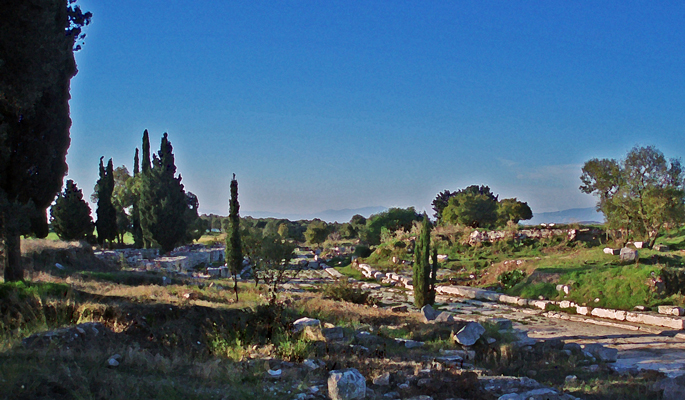
This land of gods and heroes fills me with irrational love and irrepressible longing. Here a sister married her brother and built him a tomb so magnificent it became a wonder of the world. Here, a nymph saw a young man drink from her spring and desired him so fiercely, she prayed they would never part. With cruel humour, the gods joined flesh to flesh, creating the first hermaphrodite...


This is Bodrum, once Halicarnassus, home of the mausoleum. Behind the town, hidden in hills of olive and pine, is the spring of Salamcis where the son of Hermes and Aphrodite drank. The heartland of Ionic Greece was already ancient when the Parthenon shone brand-new on the lion coloured rock of the acropolis. Cities old as time ringed the Gulf of Latmos; even then a dying seaway, choked with mud from the Meander River. First Priene and then Milatus were left high and dry.  Abandoned since antiquity they provided tourist attractions for Ancient Rome.

To one side of the silted estuary is Lake Bafa, formed by the tears of the Moon goddess weeping for the shepherd boy, Endymion. On the other, the city of Miletus, where in the Acts of the Apostles, Saint Paul awaited the Ephesian elders. Once, Lake Bafa was seashore. The freshwater lake only formed when the estuary silted. The men of Heraclea faced with the retreating sea, dug desperate channels, causing seawater to make the lake brackish. Legend says the moon goddess, Selene, was so smitten with Endymion she threatened to forsake the sky. In response, the fearful gods made him sleep for eternity and as she wept for her lost love, she cried a lake. It was a good day in November and Bafa was body warm, we swam and can confirm the water does indeed taste of tears.

The Meander estuary is now a fertile plain. Having never seen it in November we were surprised by hundreds of cotton wool balls littering the roads. It was cotton-pickin’ time. Turkish women, in traditional rural dress of headscarf and baggy trousers, picked tufts of gossamer from branches of stunted, scrawny bushes. It could have been a hundred years ago if not for the huge blocky harvester devouring the adjacent field; it’s parallel rows of vertical teeth leaving only broken, skeletal stalks. In factory courtyards were cotton castles of pearl- grey lint, while caught in the wire of the perimeter fence, grimy candyfloss streamed in the wind. The first stop was the ancient city of Eurymos. All that is left is the Temple of Zeus. We were the only people there. It was like discovering it for the first time, as if we were some Victorian explorers with Sir Richard Burton - the one who translated the Arabian Nights, not the one who married and remarried Elizabeth Taylor.

The only problem with fantasy is truth. Although sites look undiscovered they are actually the result of extensive excavation. Unexcavated, they are under 2,000 years and at least 20 feet of wind blown soil - like the rest of Eurymos. One field is the forum and another is the theatre. Each has its herd of indifferent sheep, munching as they have munched for millennia, placidly unaware of their contribution to history, falling out the other end. 


The temple of Apollo at Didim was never finished because during the centuries it took to build, Christianity became the state religion and pagan temples were abandoned. It is impossible to convey the sheer size of the site. Nothing is on a human scale, the column bases; the cyclopean stones walls - only a third of their original height. All of it dwarfs you. Awes you. It is like something built by giants. 

There is a sacred spring in the temple grounds. It had recently rained and the area was marshy. It should have prepared us for what was to come at Miletus…. It didn’t. Here we saw tortoises mating. And it was lucky they were tortoises. When Tiresias saw two snakes copulate, he changed sex. Because of his unique perspective, Zeus and Hera asked Tiresias to settle an argument about who needed love the most. Tiresisa replied that if love had ten parts, women needed nine. Hera was so furious she blinded him.  Leaving Zeus to compensate with the dubious gift of second sight.

Back at the car, we saw a stone placed at the base of a wall. As it was obviously for looking over, we discovered part of the sacred way stretching from Miletus, 26 km away, to the shrines of Apollo and his sister, Artemis. 


We had read that Miletus has a fantastic theatre but not much else. Because of this, our friends decided they had had enough of scrambling over ruins and went to the site café, leaving us to explore. 


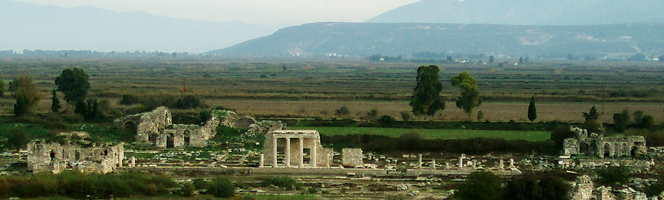
Reaching the top of the theatre we saw the rest of the city hidden to the side, the wreckage of the harbour mouth monument, now miles inland, the forum, the stoa and senate house lining the start of the sacred way. 


The site was boggy and halfway through, mosquitoes attacked. According to the guidebook the café owner was trying to sell our friends, when the Meander River silted up, the city became a malarial swamp and that was another reason it was abandoned. One of our friends said we came fleeing out of the ruins like Tippi Hedren in “The Birds” – obviously in search of a phone box to shelter in. In our defence, the mosquitoes did seem the size of Hitchcock’s gulls. 


Our friend Jack is thinking of writing a travel book and, caught up in the idea, has a tendency to pause after each utterance as if waiting for an unseen amanuensis to jot down his musings for posterity, which is probably not far from the truth as he is committing the phrase to memory for future use. 


From Miletus we drove through the alluvial plain to Priene, crossing the mighty Meander, now tamed to the size of the Regent’s Canal. Approaching the site, we saw the remaining columns of the Temple of Hera on the hillside and a ruin-lined road snaking down to the old port, now farmer’s fields. 

Priene is another huge area of tumbled stones, smashed columns and fractured walls sheltering under black cypress and pine. Unchanged since the time of Caesar and Christ, the view across the plain takes your breath away.


The next morning, no doubt due to a sleepless night of trying not to scratch souvenir mosquito bites, we were up at daybreak. Duly covered up like Turkish cotton pickers, we walked down to the lakeside to watch the full moon turn the far water silver, while the light bringer, Lucifer, the morning star, ushered in a dawn of lemon and rose – the flavours of Turkish Delight.


The rest of Paul's enhanced photos of Didim, Miletus and Priene and extensive
footnotes can be found on Flickr at http://www.flickr.com/photos/book-drawings/sets/72157625509728092/


His novel Thomas the Rhymer - 'A children's story for adults' can be downloaded from his website.


Pull Out All The Stops

Sarah McIntyre and Philip Reeve have been intrigued, entertained and amazed by Geraldine McCaughrean's Pull Out All The Stops, a brand-new sequel to her much-loved novel Stop The Train.  

Here are some photographs to prove it:
Intrigued...


Entertained...


Amazed!


Stop The Train told how the children of the prairie town of Olive, Oklahoma, manage to persuade the railway company to build a station there.  It also introduced the Bright Lights Theatre Company, and the spectacular schoolteacher-turned-tragedienne, Miss Loucien.  In Pull Out All The Stops the young protagonists, Cissy Sissney and Kookie Warboys, set sail with the Bright Lights aboard a shabby stern-wheeler, bound for adventures involving gamblers, bandits, steamboat races and Queen Victoria ... sort of.  The Bee asked Ms McIntyre to review the new book, but all she sent us were these letters...


Sarah McIntyre has just launched her own railway adventure picture book, 'When
Titus Took the Train' with Oxford University Press.


Photos by Stuart Pyle.

Fresh Pages: Samples from the Sound-World of The Books.

By Nick Riddle.

The Books (Photo: Nino P.)

Radio 3’s Late Junction is pretty good at digging up a few curious and engaging pieces from the loamy subsoil of music’s less-frequented corners. Thanks to Fiona Talkington and co, I am no longer a knee-jerk knitter of the eyebrows at the mere mention of electronica or sampling. I discovered I’m quite partial to Matthew Herbert, especially his  Plat du Jour, which does inventive things with the sound of food (and makes political points about the food industry, if you want to take such things on board), and Matmos, whose album   The Rose Has Teeth in the Mouth of a Beast revels in references to Patricia Highsmith, Ludwig Wittgenstein, Joe Meek and King Ludwig II Of Bavaria.


But best and most listenable of all is the Boston duo,  The Books. Nick Zammuto and Paul de Jong trawl through jumble sales and thrift stores for old home-recorded cassettes and use them to build, er, sound collages with music. No, that doesn’t do them justice. Their albums are stuffed with oddness, humour, non-sequitur, a kind of absurdist pathos, and - crucial, this - terrific music, inspired by minimalism and American folk and played mostly on acoustic instruments. 


The Books also ransack old videocassettes in search of footage for their videos, making them more than unusually worth looking for on YouTube. Try these two for size: The first a glimpse into the violent world of young siblings, the second a track that gallops ruminatively through someone’s four-minute daydream.  


Any of their four full-length albums is worth a go. Their DVD, Play All, is great if you like free-association montages, but you can end up feeling a bit mad if you overdo it in one sitting. You can order it from  The Books’ website.  


Nick Riddle works at Bristol University and blogs about an obscure troubadour legend at The Afterlife of Jaufre Rudel.