Click on any headline to view the full article...

Mr Levett's Scottish Tour: Part Four: Culloden

Jeremy Levett and family continue their perambulations through bonny Scotland, arriving this week at the field of Culloden where, on the 16th April 1746 the Jacobite army of Charles Edward Stuart was defeated by Government forces.  (All images in this post are taken from the visitor centre website. )


The visitor centre at Culloden had clearly had a lot of effort put into it; Paul later told us it cost the National Trust for Scotland a cool twenty million quid. I wonder how much of that went on the building (solid, grey wood), how much on the artefacts (muskets and edges, medals and pottery, woodcuts and handbills, cavalry boots and field guns) and how much on people proofreading every last line of information to keep it as neutral as possible. My dad tells a story from when he was working for Scots government, in which a senior Scot asked a junior Scot, only half joking, “Campbell, eh? Whose side were you on in the Forty-Five?” Getting on for two hundred and seventy years, and it's still an issue.


All the signs in the visitor centre were bilingual – English and Gaelic – a strange sort of sop to a set of ultranationalist Gaels I wasn’t even aware existed. Unlike the Welsh, the Highlanders seem less tiresomely attached to their old tongue; but I suppose the Welsh had no Clearing, no Culloden. The exhibition was a fairly well set out maze of corridors, with a peculiar design; on the right hand was the red wall, which told the story of the Government, and on the left the blue wall, following the Jacobites. While for the first few metres it seemed to be “pick your bias”, each wall describing its faction in glowing terms, you would then have to switch sides, as both proceeded to thoroughly deconstruct their cause and talk at length about the various defeats, setbacks and foolish mistakes they suffered in the run up to April 16. The last corridor was somewhat dodgy, using unseen speakers to play you audio clips ostensibly from soldiers on the eve of the battle; I preferred Peter Watkins' version. Then there was a reconstruction of the battle in a room whose walls were all screens, which was stylish, expensive, and in every sense visceral.


After this, the corridors panned out into a huge room full of militaria centred around a big floor screen displaying a top-down RTS style account of the battle, all Time Commanders-style (I wonder if they actually used the Total War engine...)., and then a door to The Place. The field itself isn’t much to look at. Well, it’s a field, what do you expect? There are rows of red and blue flags showing the original line of battle, GPS-linked audioguides that play you a clip when they detect you’re on a certain piece of ground, a great big stone memorial to the Romantic Lost Highland Cause, and a great many small monuments celebrating where individual tartans were gunned down. There was only one memorial to the Government's troops (who were, in case you didn't know, as much Scots lowlanders as Englishmen): “FIELD OF THE ENGLISH; THEY WERE BURIED HERE.” Mum got the impression that was biased towards the Government, in emphasising the Highlanders' failures and making little of the Government's losses; I felt it was entirely the other way round, with a soulless and inaccurate monument to Cumberland's troops but a trashy Victorian headstone for where every chieftain and famous clan was heroically escorted from this vale of tears by Brown Bess.

It was a tricky one; the Gaelic, the romanticism and the serious wait before the museum got around to mentioning the actual outcome had me rather annoyed at a perceived pro-Jacobite slant, but by the end I wasn’t so sure. The disgusting Victorian Bonnie-Prince-Charlie-on-a-bottle-of-Drambuie ahistorical romanticised kitsch that no true Scotsman on either side actually believes has left its mark, perhaps indelibly, and even in this most truthful of exhibits there still seemed to be a hint of That Noble Lost Cause; but maybe this is a knee-jerk response I have that objects to any recognition of the Jacobites as anything but doomed, misguided idiots on the wrong side of history.

In modern parlance, you can call the Forty-Five a heroic act of defiant independence against economic tyranny (under Union rule the lowlanders and city folk were prospering, the Highland crofters and smallholders not so much) and religious persecution, betrayed by incompetent leadership. But in that same modern parlance, the Jacobites were a foreign-backed insurgency of a small minority attempting to violently overthrow a legally elected, popularly accepted government, and replace it with an absolutist monarchy. Still sound romantic to you?


The displays were informative, the artefacts plentiful and well-chosen, and the audiovisual stuff of extremely high quality; it’s a serious, no-nonsense account of Culloden in all its brutal detail and desperate futility, and you really could see where the £20m went.


By the by, Bonnie Prince Charlie was a prick.


Mrs Tinne’s Wardrobe

Natalie Crawford reminds us that they also serve who only go and shop...


As we remember the brave fighters of 1940’s Battle of Britain, I am put in mind of all the various war era heroes that go unsung. There were so many spectacular acts of bravery and kindness by every day people during both wars and the depression in between, that they are too numerous to count. Of course on occasions such as these we should commend the men and women who put their lives on the line for our freedom, but I would also like to take a short moment to remember the lesser known who ‘did their bit’ for Britain.


One such philanthropist was Mrs Emily Margaret Tinne. Born Emily McCulloch in 1886, this remarkable woman, brought up in a staunch Presbyterian household, could have had no idea how her path in life could affect others so profoundly. Despite her modest upbringing, Emily was to marry into the exceptionally wealthy Tinne family of Liverpool in 1910. Her husband Philip was a local doctor but also heir to the Tinne fortune (derived originally from the family’s sugar and ship businesses).

This dizzying wealth undoubtedly took its hold on Emily as she was suddenly able to afford any luxury she desired. However, she still maintained a modest appearance and did not flaunt her new found wealth openly. Even so, she is thought of as one of England’s first, and finest, shopaholics as she amassed a secret collection of thousands of items of clothing, many of which she never wore. It is this prolific spending that makes her a minor heroine in her own right.

During the first half of the twentieth century, shop assistants did not take a wage, they worked simply on commission. Obviously, during the war years and the depression these girls would have been taking pitiful pay packets home. It is thought that Mrs Tinne, each afternoon, would head into Liverpool to go shopping. She combined her new found love for retail with her desire to help those less fortunate than herself. She would purchase outfit upon outfit (often multiples of the same style) because she could; because this was her way of contributing to the war effort and to the helplessness of situation young people found themselves in.

She herself was not a flamboyant woman and had trained to teach before she met her husband. Being thrown into such a dynasty, Emily quickly found herself without occupation; her children had nannies and she was not allowed to work. Shopping and providing vital commissions became her livelihood, became her purpose for being. Without it, many shop assistants in Liverpool would have been a lot poorer, and we would have been deprived of a perfect cultural snap shot.

Liverpool Museum are now proud owners of much of this vast collection and back in 2006 displayed articles free of charge to the public. The book of the collection, “Mrs Tinne’s Wardrobe: A Liverpool Lady’s Clothes 1900-1940” is a beautiful and intriguing record of her life; a must have for any fashion or historical enthusiast. It provides a brief history to Emily and the Tinne family as well as detail on Liverpool shopping at that time. The collection included covers a vast array of her garments from everyday dresses and evening wear to stockings and swim suits. Each example is photographed in full colour alongside a detailed description of fabric, stitching, cost and, where possible, information as to the occasion on which it was worn.

The collection spans the period from the First World War onwards, and ends abruptly in 1939 - It is thought that even Mrs Tinne’s wealth could not avoid the rationing of the second world war, forcing even her to make-do-and-mend. But photographed alongside her wardrobe are some of the sewing patterns she also bought, which undoubtedly came in useful during more frugal times.

The catalogue book is stunning and very often I sit to simply flick through the pages, wishing somehow that these incredible fashions would come back in. It is a veritable time line of silks and velvets but does not discount the more accessible middle-class garment. As she was a humble woman, it is one of the very few collections that not only includes the glamorous but the mundane as well. 

Mrs Tinne passed away in 1966 leaving all her articles to her children. When her daughter came to clear the family home, she found piled chests stuffed with clothing still sitting in place as a barricade which Emily formed in fear of invasion during the Second World War.  As well as this, she also had whole rooms dedicated to her clothes and accessories. Whether her purchasing intentions were actually heroic, we may never really know, but I like to think they were. I would love to have seen those shop girls’ faces, filled with relief and gratitude as Emily Tinne walked in.

I doubt very much if she knew the legacy she was leaving, but it is one makes the heart warm.

Publisher: The Bluecoat Press (2006)   ISBN: 978-1904438205 
RRP: £15.99 


LINKS:


Summerland

By Philip Reeve


I have a new FLA, or Favourite Living Author!*  Michael Chabon is the author of The Wonder Boys, a very funny academic farce which is also one of the best books about the business of writing novels that I’ve ever read (and adapted pretty well into a Michael Douglas movie).  He also wrote The Amazing Adventures of Kavalier and Clay, a moving and hugely readable story about the creation of a 1930s comic-book superhero, and The Yiddish Policemen’s Union, an extraordinary, unmissable, iced-noir detective thriller set in a Jewish state in Alaska - a state which, in the real world, was proposed in the 1930s but never actually existed.  His swashbuckling historical fantasy Gentlemen of the Road comes wrapped in reviews comparing it to Melville, though it seemed to me to be a loving tribute to Fritz Leiber’s tales of Lankhmar.  And his novella The Final Solution seems to spin off from the uncomfortable way that the phrase ‘the Final Solution’, despite its awful historical weight, sounds rather like the title of a Sherlock Holmes story...
 All these books tell gripping tales, and tell them in prose dense with wild ideas, sharp dialogue and beautiful description.  None of them, I imagine, would be suited to readers much younger than 16.   But happily Mr Chabon has also written a novel for younger readers which should appeal to any child who enjoyed His Dark Materials or The Lion, The Witch and the Wardrobe.  
Summerland, published back in 2002, is an American fantasy in the tradition of Ray Bradbury and L Frank Baum.  It starts off in the present day on a small island in Puget Sound, but quickly takes its young heroes, Ethan and Jennifer T, on a breakneck journey into three other worlds, all of which are under threat from a surprisingly charming and likeable villain called Coyote.  This fantasy universe is woven from a mixture of Norse and Native American mythology (which seem to go together rather well) and it has a simple logic which makes it feel instantly right.  There are fairies (here called Ferishers), Bigfoots (or do I mean Bigfeet?) and a pleasingly wild and weird array of demons, were-folk, dim-witted giants and oracular clams.  There’s technology as well as magic, though; Ethan’s father is building a prototype airship, and Coyote’s army of goblins and werewolves ploughs its way across the worlds aboard a fleet of armoured cars and steam-powered sledges.  
There’s also quite a lot of baseball, or ‘rounders’ as we call it in this country, which is a bit of a drawback for the British reader.  What is it with American writers and baseball, I wonder?  I’ve always believed that team sports are the opposite of novels; writing fiction is a solitary expression of individuality, while sport submerges the individual in a collective and binds them with all kinds of silly rules.  But American novelists, from J.D Salinger to John Irving, from Don DeLillo to Dennis Lehane, keep coming back to the image of the pitcher’s mound, the home run, the Catcher in the bleedin’ Rye.  In Summerland, the game of baseball is one of the things that link all the worlds, and the final conflict which determines their fate will be played out not on a battlefield but on a baseball diamond.  Apparently a game of baseball is really ‘a great, slow contraption for getting you to pay attention to the cadence of a summer’s day’.  
Well that sounds nice, and if I thought for a fraction of a second that it was true I might take the trouble to actually look up the rules of baseball, so that I’d know precisely what was going on during the various matches which occur in Summerland.  But in the end I doubt it really matters, any more than not understanding the rules of Quidditch matter when you're reading Harry Potter.  All you really need to know is who’s on each team, and who wins or loses.  And the ultimate winners in Summerland are its young readers; they are taken on a splendid trek through the imagination of a great writer, who doesn’t flinch from showing us the sadnesses and disappointments of life, but is still able to end his story with a positive cascade of happy endings.

(*He’s not quite at the top of my chart; that position is reserved in perpetuity for Geraldine McCaughrean, Head Girl of modern children's fiction.  But he’s currently number two.)

A Conversation with Sarah McIntyre


Should anyone be this talented?  Philip Reeve talks to the illustrator, writer and comics-creator Sarah McIntyre about sheep, rabbits, the Saturn V rocket and how to avoid crevasses.


PR: So, who is Sarah McIntyre?


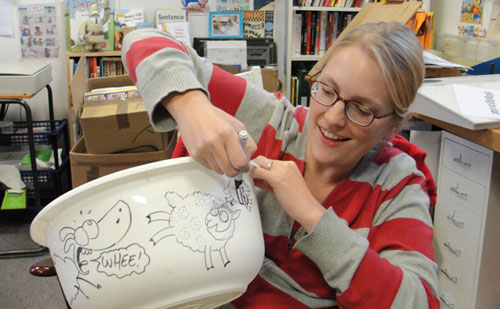
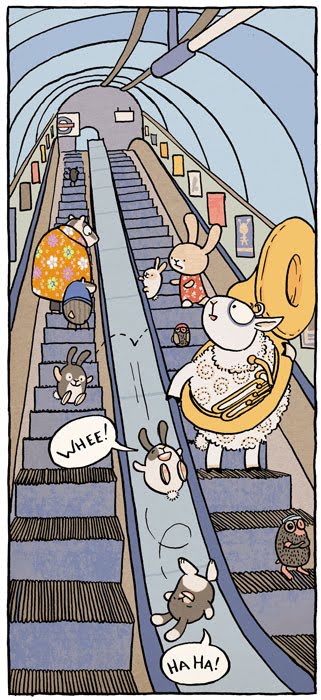
SM: Hi, Philip! I can give the easy answer: I work as an illustrator, and have three picture books under my belt since art college:  Morris the Mankiest Monster, You Can’t Eat a Princess! and When Titus Took the Train. But more and more I’m writing my own stories for my characters, and the first to launch is a comic book called Vern and Lettuce, which is part of the DFC Library series of comics. It stars a sheep and a rabbit who live in a tower block in a neighbourhood very much like my own in south London. While Lettuce the rabbit is watching a talent-spotting show on telly, she suddenly decides she  wants to be famous, and scoots her best friend Vern off to the big city, despite his protestations that they need to work on getting a talent first.  They are both hugely inept at doing most things, but while reading, you hope that the strength of their friendship will help them survive in dark and dangerous places.


I got thinking about the more complicated answer to ‘who is Sarah McIntyre?’ while I was reading Fever Crumb and A Web of Air for the first time this week. Identity plays such a central part to the story, and sometimes all Fever knows for sure is her name.  Just as, in the book, Fever was packing her bags to leave her Order of Engineers, my dad was also clearing out his office and hanging in his badge to leave his own order of engineers,at Boeing, in Seattle, where he’s worked since he emigrated to the USA from Scotland, over 40 years ago. Dad’s identity is hugely caught up in his role as one of America’s leading aeronautical engineers and it’s not an easy thing for him to step out the door and lose that status, so he’s been on my mind a lot.  (Who is Mr McIntyre?) Both Fever and I grew up surrounded by engineers. My godfather was one of the chief engineers on the Saturn V rocket and, with his completely bald head, thick black glasses with tinted green lenses and fierce demeanour, he could have been straight our of one of your books. I loved him but he was a strange man. My dad’s best friend and colleague salvaged the wreck of a Mustang P-51 fighter plane which had crashed near Havana and rebuilt it to perfection in his garage. He had his 6-year-old daughter do some of the plane’s wiring because her hands were small enough to get into the gaps, and by that age, she’d memorised several of Winston Churchill’s speeches. Dinner parties were fascinating tales of war exploits and British politics. (I was always stricken with grief when too many children were present and I had to sit at the kids’ table.) But I was glad my dad never worked in Boeing’s military wing. One of his colleagues who lived down the street worked in what was called ‘The Black Hole’ and he couldn’t tell anyone about his work or where he might travel. My dad shared a lot about his work with me, but frustratingly I didn’t seem to have the right computer chip in my brain to grasp complicated physics and calculus. We did some great science projects together, though, such as building a working model of Foucault’s Pendulum in a gymnasium, using a fishing weight with a pencil on the end and an incredibly long rope to the ceiling. 


Besides airplanes, Dad’s obsessed with mountaineering and exploration, and made sure my sister and I were adept at ice axe arrests on steep slopes, and hauling ourselves out of glacier crevassas with Prussic slings. We each climbed nearby Mt Rainier with him and his climbing buddies when we turned 16; it was our proof to him that we’d reached ‘manhood’.  I owe a lot to my dad for giving me a strong sense of identity.  And A Web of Air reminded me of how I’ve been fed, doctored and educated thanks to the secrets of flight. On one hand, it’s hard science, but these guys imbue what they do with a certain romance, they’re passionate about their work, and with pushing the limits of what humans can achieve.

PR: I get very tired of hearing writers and artists defining themselves as ‘creative’, as if what your father and godfather did isn’t!  It’s hard to imagine anything much more creative or romantic than the Saturn V rocket and the Apollo programme.  Yet I remember reading somewhere that an extraordinarily high percentage of the American public believe the moon landings never happened.  It’s quite easy to imagine that in a few more generations nobody will believe it, and these vast achievements might be forgotten...  

SM: Yes! A Leeds-based friend of mine, Darryl Cunningham, recently made a comic strip about just that topic, called The Moon Hoax. He’s been tackling several controversial subjects, such as mental health issues, the MMR scandal and homeopathy; comics have been a great medium for telling the stories of the debates in an engaging way, and comics format is much more pleasant to the eye than a huge chunk of scientific text. Darryl’s had an overwhelming amount of response on the internet, hundreds of comments for every strip.  I think he would appreciate Fever Crumb’s argument that it’s easier to suppress truth with religion than with anything else. A lot of these people who argue with each other in his comments have strange religions, not necessarily god-based, sometimes even supposedly reason-based, but they have certain things they insist on believing despite all evidence to the contrary.  Linked to what we were saying earlier, I think it’s all caught up in identity. People want so desperately to have something they can call all their own and know for certain, and it takes a lot of maturity to be able to step back and say we don’t know everything. We want to make sure we’re securely roped up to other things we believe before we walk over those crevasses. 

The Dark Night of the Soul... Oh,
all right, it's a dinosaur on a swing.
I’m fascinated by accounts by Catholic contemplatives of a certain ‘dark night of the soul’. Sometimes I think it’s when the bottom drops out for people that they really have to let go of everything they believe, flounder, and then possibly grow. I saw it happen to my dad. Even though he was an engineer, he was quite up-tight and religious when I was little, didn’t want me to watch telly or listen to rock music. But when my little sister became a teenager, she unleashed hell on our dad and completely broke him, reducing him to a tearful wreck, night after night for several years. It was horrible to watch. But over the course of several years, my dad learned to let go, and his attitude toward religion changed, becoming much gentler, realising he couldn’t see the big picture in a way his God could, and accepting that love was more important than banging on about theological points. And he and my sister have a deep bond of understanding now and compassion for each other that’s very moving. …Sorry, this is all getting a bit heavy!


PR: Still, it’s a relief to know that you won’t be falling into any crevasses.

SM: True! But it might be good for me, the blue night of the soul. They are really very blue when you get down there.  I’m curious about you, Philip, was there anything that made you particularly interested in machines and engineering, or did they just fit well with an overall story you wanted to tell? 

PR: I never had any interest at all in machines and engineering, which is probably where things like Mortal Engines come from - when I looked at machinery I had no more notion of how it worked than would a mediaeval peasant; it might as well have been magic to me.  My books are full of cartoon contraptions, really.  The flying machine in A Web of Air is my first attempt at writing about a machine that could actually work, although I’m sure Mr McIntyre would find many faults with it!  On the subject of flying machines, I noticed a nice airship strip on your website...

SM: I can relate to that! I don’t understand most of the technology involved with aircraft, but I love the stories they evoke. Airship was a great example of that. My friend David O’Connell and I kept spotting the Stella Artois airship over London. One day I was sitting working at my desk and started daydreaming about the airship, and about 20 seconds later, it nudged its way past my window, as if I’d summoned it. Made my skin prickle! Often I’d be on my bicycle and I’d look up and there it would be, hanging over me.  I found its huge, silent approach both unsettling and strangely reassuring, and the airship started to take on mythical proportions in my head. When David and I decided to do a comics jam together, we chose the airship as our story’s starting point.  We usually met up at the Tea Pod cafe on Shad Thames, which, if you look up,  has a sky ceiling crisscrossed with lovely footbridges which date back to its old shipping days. We started the comic fairly autobiographically, then let it fly off into wild silliness. It’s one of the most fun projects I’ve ever done; every time I’d send off a new panel to David via e-mail, his follow-up panel would ping back within a day, going somewhere I never could have predicted. I love working collaboratively with someone who’s very talented but thinks completely differently than I do. It’s like my characters take on a real life of their own, and go on to have adventures where I’m only playing a part in them. It’s more like real life, where people can be encouraged in a certain direction, but never entirely controlled, and the joy is in seeing what they do with their freedom. 

PR: Final questions: What's next? Will there be more Vern & Lettuce books?  

SM:  I have a whole bunch of picture books lined up with David Fickling and Scholastic, and yes, one of them is a Vern and Lettuce picture book! I’m a bit apprehensive about starting another Vern and Lettuce comic in completely the same format because it was so hugely time and labour intensive. I’m weighing the idea of simplifying the comics format, maybe giving them something like four panels per page, a bit like Reflections of a Solitary Hamster by Astrid Desbordes and Pauline Martin. There’s no reason each page has to be so complex all of the time. I drew 8-12 panels per page because each page was a weekly strip for a magazine and had to be complete in itself, but if I was approaching it as a book, I’d let the story run much more fluidly from page to page. But I think it works well in this book, particularly for people who aren’t used to reading comics;  they can catch their breath between pages if they want to, even though there’s an overarching storyline. I’m too fond of Vern and Lettuce and their neighbours to let them go. They feel like family and I’d miss them too much. They all have complicated back stories and are hopping around in my head like children who really need a wee. I’m not cruel enough to keep them waiting like that for too long! Although if we’re talking in terms of long publishing timeframes, I think we may have a few little puddles on our hands before then. Poor little guys.


Mr Levett's Scottish Tour: Part Three

Photograph: Anne Burgess

In which the Bee's Jeremy Levett and family continue their travels in Scotland.

There seem to be only two things of real interest in this part of Scotland: distilleries and military things. Fortunately, it has an ample supply of both. The Speyside distilleries are legendary and legion; every town seems to have one or two, a whiff of spirits or malting barley will be caught on every car journey, and the distinctive pagodas poke up from glens in the unlikeliest of places.
And the military history of the place is as drawn-out and messy as being torn apart by wild tortoises. Bronze and Iron Age forts, old as the hills they resemble, litter the place; the Antonine Wall is merely the most impressive of the ubiquitous earthworks. Castles and bastle-houses in varying states of tweeness and collapse are everywhere, military roads made by the Romans and General Wade criss-cross the countryside. There are old battlefields here from tangles with the Covenanters and Jacobites, Culloden greatest among them. Radar installations and early warning systems from WW2 onwards dot the hills, pillboxes and tank traps on the beaches here were used in dry runs for D-Day, and, of course, every town has its bronze and marble cenotaphs, some – as is so common – with names from the second big scrap joining those of their fathers who fell in the first. Nowadays there are RAF bases flying Nimrods up over the North Sea, patrolling for Soviet submarines that have been rusting off Murmansk for decades, and flights of Tornados thundering across the sky training for a war they’ll never fight.
Most obviously, most impressively, and quite probably most permanently, is Fort George.
After Culloden, we now know, the Jacobite cause was thoroughly broken and no further battles would be fought on British soil; but it wasn’t that obvious at the time. Fort George was built on a spit of land out in the Moray firth downstream from Inverness with the stated intent of being a fort and supply depot impregnable to uncivilised Highland types. Given apparently unlimited budget, the designer seems to have expected the Highlanders to have the fighting capability of large and seriously tooled up Continental armies. It’s a trace italienne style castle, a star fort (I can make a Trace Italienne Fortifications For Normal People in the style of the Antonine, if anyone is interested. Should I be worried about this becoming an archaic defences blog?) with that curiously pointy design that really only makes sense from above, immensely thick, low walls in geometric shapes to maximise overlapping support and fields of fire: demibastions covering bastions covering ravelins covering artillery-proofed glacis killing-fields.

For whatever reason, the place was insanely popular with seagulls, and there was no single square metre of the fort which didn’t have some... evidence of them.
Nick was coaxed out of the car for a change and frog-marched onto the bastions to Enjoy. There was an excellent audio-guide, which attempted (and succeeded) to give an impression of life as a Fort George squaddie, ie cold, hungry and unpleasant. While I never have time to listen to everything in an audio guide, and always guiltily give up on them halfway through, this was a pretty good one; accounts of the designs and architects (the famed Adams, who used the military contracts to jump-start their civil business) and changing use of the fort (by the time it was finished, the Jacobite threat was long gone, and heavy guns were installed on the seaward walls to cover the Firth from French ships) were mixed happily with an account of a soldier getting a hundred lashes for stealing a handful of potatoes (pay and rations were awful, which has always struck me as an example of total, criminal incompetence in a military establishment.) Much was made of both the historically dilapidated, unmaintained state of the barracks buildings and the endless boredom of the garrison, which seemed strange; surely one is a pretty good solution for the other? 
One of those barracks housed the regimental museum of the Camerons and Seaforth Highlanders, whose faithful service to the Crown dates from only a few years after the forces of that Crown massacred their kinsmen at Culloden (no hard feelings) which had the usual mass of militaria and a staggering amount of battle honours. Pick a British campaign after the 18th century, any campaign, and there is a case in that museum about the Scots that killed and died on it. Perhaps there was something wrong with the climate control, or the gear needed to be reminded of Khartoum and El Alamein to avoid falling apart; either way the place was ridiculously hot.
The powder magazine housed a collection of old equipment bought by a local noble, who kept raising regiments nobody wanted and having to disband them again. The masses of India Pattern muskets and pikes, which are ten-a-penny in collections, were joined lots of shoe buckles, cartridge pouches and knapsacks, which are conversely very rare in the field of military leftovers. The bastioned nomshop was great, selling solid, unpretentious food at solid, unpretentious prices, as well as the NAAFI being open to civilians. The chapel, at the most seaward point, was the last thing added to the fort (the budget apparently allowing for holiness as well as impregnability) and included in its stained glass the only known bagpipe-playing angel in Christendom. We spent a good couple of hours exploring and trotting round its endless ramparts, and saw porpoises plorping about in the firth.
On the way back, we stopped at an eco-thing at Findhorn, like a rather less interesting version of the Centre for Alternative Technology, whose green hippie eco-establishment credentials were eroded somewhat by being right next to a massive air force base. Then, near a viewpoint on top of icehouses, overlooking one of the many had-it fishing ports of the coast, Dad went into a Nepalese bazaar (no kukris :C) and bought an astoundingly unflattering fair trade shapeless green-grey top thing.

On the Monday, we took the coast roads to explore Fishing Villages, eating honeybee sweets and mint colonials along the way. There's lots of geology going on around here, and from down on the beaches you can see the many-coloured bones of the hills in cliffs above.
Principal planned attraction for the day was the lighthouse museum at Fraserburgh. Sadly, to get there you needed to get through Fraserburgh, which is the poster boy for fishing towns that have seen better days: utterly dreary, miserable and dying, all its life and charm replaced by commercial machinery that's now unused and idle. The museum itself was fascinating, full of those huge multi-piece refracting lenses and a million interesting things I didn't know about lighthouses, and finished with a tour of the Kinnaird Head lighthouse. They had kept the old tower as spick and span as when it had still been in use (a smaller, more modern, steel and plastic house now shines), and the light itself, all polished brass, thick glass and intricate iron, was so smooth on its bearings I could turn it with a single finger.

A Conversation with Alex Keller

Alex Keller’s debut novel Haywired has been getting a lot of attention in the Bee’s corner of the blogosphere lately.  Subtitled 'A Steampunk Fairy Tale', it takes place in a sort of Brothers Grimm world in which the magic has been replaced by Weird Science.  To mark its official publication day Philip Reeve talks to Alex about fantasy, steampunk, and the ideas behind his book...


PR:  So, what is Haywired?
AK:  Haywired is my first attempt at writing a proper story. I spent time working out exactly the sort of things I really enjoy when reading, and tried to put them all together in this book. I wanted to create strong, engaging, and realistic characters in a world that felt both fantastical and very real at the same time.
PR:  The world of Haywired, with its warring nation states, feels vaguely European, vaguely 19th Century.  What inspired that setting?  As the geography expands in the sequels will Pallenway and Galleesha turn out to be part of Europe, or is it a complete fantasy planet?  
AK:  The world in which Haywired is set is a complete fantasy world. I wanted it to have my own world with it's own politics, history, etc. If I had set it on Earth I could only really write it as an alternative history, (which I'm not a big fan of), or as a decaying future, (which has been done already). Making a whole new world meant I wasn't limited by anything other than the world's own internal logic. If felt like a challenge to create it from scratch, and I think I had more fun doing it this way was well. 
With regard to the European Nineteenth Century feel, this was very much what I was aiming for. I see the Nineteenth Century as a really interesting period in history. It was a terrible time in many respects, but it was also chaotic and exciting and a huge amount of change was occurring. However, Haywired isn't set in the 19th Century on Earth, so I could add things that would never have existed then. Also, while this is not really made obvious, the world of Haywired is also slightly reflective of the Greek World after the death of Alexander, and the 16th Century of  the Hapsburg family. I basically took the bits of Earth history I find interesting and combined them into a world that I could tell stories in. 
Geographically, Pallenway and Galleesha are very similar to England and France (the name of the Capital of Galleesha is very similar to the earliest name of Paris). Politically, I'd say the warring nations reflects pretty much most of European history, however, a major element of the history of Pallenway and Galleesha is that these countries are the fractured remains of an empire, and here, as mentioned before, I had the death of Alexander in my head. I liked the idea of a world that's trying to find itself after the old order has collapsed. 
PR:  Though it has to be said that very little of this history is actually mentioned in Haywired.  Indeed, you seem to have kept the description and background detail to a bare minimum. Was that a deliberate decision?   
AK: Yes and no. Earlier versions of the book had much more about the history of the characters and the world they are in. A scene where Ludwig visits Mrs Pewsnitt and she tells him about the events that led to his grandfather's death was taken out, and also scenes that look at Sir Notsworth's relationship with Mandrake, etc. However, my editor thought is best to keep the story more direct, at least for the first book. Since it's really aimed at ten year olds and slightly older, this probably was for the best. Also, it gives me more content to include in later books. 

The Steam Man of the Prairies -
none more steampunk...
PR:  What do you reckon to this ‘Steampunk’ lark, then?


AK: For me it was the best means through which I could bring together the elements of fantasy and science fiction I enjoy, but avoiding some of the issues that can arise in both genres. I like fantasy for example, but I find the vast majority of the genre a bit dull; like everyone is writing JRR Tolkien fan fiction rather than coming up with ideas of their own.  
PR: I've not read much 'high' fantasy.  I loved Tolkien and Alan Garner and Lloyd Alexander when I was a child, but they were enough; when I wanted fantasy I just re-read them. Most of the fantasy I see reviewed these days sounds more like Fritz Leiber than Tolkien - lots of grimy, sprawling cities with Thieves' Guilds and Catacombs and things.  

AK: I 've heard that city-based fantasy stories are big these days. I'm not dismissing all fantasy by any means, and like quite a lot of it, but another issue that can arise with high fantasy especially is the worlds can feel very static. Authors seem to write the history of their worlds and, while big events may have happened, technology hasn't progressed or politics changed or anything of that ilk for thousands of years. This seems a bit daft to me. Also I'm not a big fan of magic in stories. There's something too easy about it. I'm not saying it's done badly all the time, but if you use magic in a story anything is possible. A character is never really in danger because they can wave a wand and materialise somewhere else. To be fair, there are a number of writers who have written magic well (Pratchett and Eddings immediately spring to mind), but I think a story can lose a lot of tension when you include magic.  I guess what I'm getting at is that steampunk offers an alternative means of creating fantasy worlds that aren't steeped in knights and dragons and magic. 
PR:  I think that's what drew me to it originally too, although these days I'm starting to think that steampunk actually offers a far more limited set of possibilities.  Airships, automata, a Looming War between the Great European Powers... it's a hall of mirrors! Though to be fair I guess all genre fiction relies to some extent on recycled imagery and cliches, and the pleasure of reading it is watching a good author rearrange the familiar furniture in their own way.  Also, the fantasy we were talking about is just one subgenre; there are plenty of good writers ploughing their own little furrows and turning out wildly original work (I'm thinking of people like Neil Gaiman, MT Anderson and the superb Margo Lanagan).  But I do know what you mean about magic in stories. I've always found it impossible to write about magical goings-on myself, although of course there are lots of books and films where it's used wonderfully well.  And if we're honest, waving a magic wand isn't the only way to get characters out of trouble; anyone who's ever watched Dr Who or Star Trek knows that sci-fi has its own set of get-out-of-jail-free cards - you just re-route the tachyon modulators through the photonic plasma manifold and Bob's your uncle...
AK: That's true. If technology is sufficiently advanced in sci-fi, it can have the same effect. I think that's why I like science fiction books where the technology is flawed and humanity is still rather fragile.
PR: Speaking of which, what would you say are your big influences? 
AK: While I wrote Haywired, I had two books next to me pretty much all the time. The first was The Amazing Maurice and his Educated Rodents. I love Terry Pratchett, and I think this is his best children's novel. It funny and dark and moving all at once. The second was Mortal Engines. It's a brilliantly fun and exciting adventure, and the moving cities are fantastic creations. Whenever I got stuck, I would pick up one of these and read. I'd then compare what I had written and change it whenever it didn't match up. I'm not saying I succeeded it copying the styles of these books, but they did help improve my own writing. 

PR (Blushing modestly): I read an interview where you described an earlier version of the story, about a descendant of mad inventors living in the present day, who still does a bit of mad inventing to keep up the family tradition.  I thought that sounded great!  Is there any chance that you'll go back to it?  
AK: I liked that idea too, although I thought that it seems a bit too ordinary, with kids going off to rescue their parents and so forth. I might have a stab at it sometime but improve the story.
PR:  I just thought the set-up sounded nice; I imagine a perfectly ordinary suburban house with a huge Frankenstein laboratory in the loft or the spare room.  And the idea of the father doing all these mad experiments just out of a vague sense of duty...   I do think you should keep it on the back burner.  You never know when these ideas are going to come in handy!   I know there's a sequel, Rewired, in the works.  Do you have plans for further books after that?

AK:  I've got ideas for another two books in the Haywired series after Rewired. However, whether they see the light of day is another matter. Hopefully Haywired will be popular enough to carry on!   I've also got ideas for a few books that wouldn't be related to Haywired. There's one especially that I'm hoping to get finished by the summer and I think it could be really good. I'm still only working on the storyline at the moment though.


Haywired is available from all the usual places, including this one.